
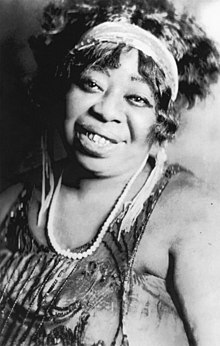
Ma Rainey was born with the name Gertrude Pridgett. Although Rainey claims to have been born on April 26, 1886 in Columbus, GA, the 1900 census indicates that she was born in September of 1882 in Alabama. Raised in a family of five children, Rainey quickly began performing at the age of 14 as a member of the First African Baptist Church. She eventually met her husband, Will Rainey, and thus her name transitioned from Gertrude Pridgett to Ma Rainey. Rainey and her husband performed music, becoming very popular and were called the “Assassinators of the Blues”. Her popularity grew over the years along side Blues music and was one of the pioneers for the musical genre.
Her popularity eventually crossed paths with legends such as Louis Armstrong, Thomas Dorsey, Joe “King” Oliver, and much more. Rainey signed a recording contract with Paramount, producing over 100 records over the next five years – further spreading her popularity across the South. This is when she earned the title “Mother of the Blues” as a marketing ploy. However, this stayed close to the truth because Rainey left such an incredible legacy in the music, Blues music, and African-American culture and industry. She was inducted into the Blues Foundation’s Hall of Fame in 1983 and the Rock and Roll Hall of Fame in 1990.
Ma Rainey’s original performance of “See See Rider” is quite an amazing one. It became a standard recorded by countless in many genres, including Elvis Presley. Ma Rainey performed this song as a mixture of blues and other popular music forms, primarily jazz. It doesn’t follow the blue’s standard twelve-bar blues and encompasses more variety of instrumentation – contrary to a blue’s typical single guitarist/pianist and vocalist. She performed this piece with the Georgia Jazz Band which included a banjo, a cornet, and a piano – untypical of a traditional blues song. Rainey performs in a very low-moaning melody with a structurally andante tempo. It’s clear that Rainey’s vocal performance is the key focus here, going from a high pitch to a low pitch as she sings. I think this provides a nice contrast of distant change compared to the static background band melody. The song does a play on words with “see see rider”, making it sound like “easy rider” which changes the story of the music. In dirty blues songs, easy rider refers to a woman who had very liberal sexual views, had been married more than once, or was skilled at sex. Most critics would argue that the rider referred to in Rainey’s song is about a man, but with the play on words could be referring to a prostitute – thus changing the story of the song.
Compared to “See See Rider”, “Countin’ The Blues” follows a more standard twelve-bar blues pattern with a simpler vocal (Ma Rainey), piano (Fletcher Henderson) , and cornet (Louis Armstrong) instrumentation. It plays in a very slow but steady pace with the instrments backing up as a fill after the end of Rainey’s verses. I really enjoy the follow up of the instruments after the verses as it plays similar fashion to a vocal-fashion – making it seem like the instruments are singing, rather than playing. It’s amazing to also hear Louis Armstrong’s famous “wah-wah” play style in his cornet as he provides a fill!
Sources
https://www.aaihs.org/slavery-new-orleans-and-the-counting-blues/
 Sunny's Musical Blog