Musical Web – Final Post Portfolio

Maple Leaf Rag

Every time I listen to Maple Leaf Rag, I always get Charlie Chaplin vibes. The timbre of the notes are short and light, as if they’re on tippy toes. The syncopation of the low-key melody contrasting with the high-key melody works great to provide a lot of character and very characteristic of ragtime. The song rises and falls in the pitch of the notes, almost feeling like it’s making a point across – like the climax of the story is occurring. Written by Scott Joplin, it proved to be one of the most famous ragtime music in history and laid the foundation for future iterations.

Written in an AA BB A CC DD structure, Maple Leaf Rag provides a march rhythm with the bass melody of the left hand. The right hand plays the off tune high melody. I would describe the harmony of the piece to be chromatic – rising up and down as the music progresses and bounces off the marching rhythm of the lower keys on the left hand.

Maple Leaf Rag falls into many categories of Candelarai’s streams of music culture. It earned Joplin the title of King of Ragtime due to its immense popularity and created a basis in which future ragtime iterations would rely upon. Ragtime music is also an influencer on the later future jazz.

The Super Mario Bros. Main theme song was composed in 1985, very close to 100 years after the composition of Maple Leaf Rag in 1899. The theme song for the immensely popular game Super Mario Bros. features very similar syncopation. It is stated that the theme song for the game was influenced by ragtime music – having similar melodic cues such as the polyphony of the two low-key and high-key melodies.

Zydeco Sont pas Sale

Performed by Clifton Chenier, his brother Cleveland Chenier, and John Hart, Zydeco Sont pas Sale represents the Creole/French music culture of zydeco in southern Louisiana. The instrumentation of the piece consists of the traditional washboard and accordion with the drums supporting them. A simple instrumentation set up like this makes it easy for people to play zydeco type music in social settings, involving family and friends. The tempo of the song is very fast with Clifton leading with vocals.

This form of music fits into the stream of Candelarai’s of Folk and ethnic music as zydeco represents the mixture of French and Creole culture. Because of the historical influence of being a fast tempo and dance-driven song that was played in social settings, zydeco played a large rule in the future of blue, hip hop, and rock and roll.

One of the influences of Clifton Chenier’s song is Don’t Mess with my Toot Toot by Sidney Simien, aka Rockin’ Sidney. Considered his biggest hit, Rockin’ Sidney performed various R&B, zydeco, and soul music in the 1950s. His song Don’t Mess With My Toot Toot takes a lot of cues with traditional zydeco, which can arguably be awarded the father of modern zydeco. Sidney’s song follows Clifton’s renditions with a drum and an accordion. They provide very similar melodic cues and tempo – fast and upbeat, maintaining a lively dancing mood.

That’s All Right

My initial listening log was transfixed on the fact that I was surprised this song was not an Elvis Presley original but rather it was a rendition by him from a different artist. Upon my new listening, I notice sort of the subtle influences of zydeco in this piece. As mentioned before, zydeco influenced a variety of modern musics, including Rock and Roll. The instrumentation of the song That’s All Right is clearly far from the traditional zydeco makeup, but the timbre and tempo of it is very familiar to zydeco. Instead of the traditional washboard pushing the tempo, they produce a similar result and sound with the light tapping of the drum sticks. It plays off beat along the main melody of the vocals. The guitar melody followed by the drum sticks hitting twice really replicates the feel of the washboard sound in Clifton’s song.

That’s All Right fits into the rock and roll stream of Candelarai’s streams, because of the genre. However, as I mentioned in my re-listening of it, it follows very subtle throwbacks to folk and ethnic streams of zydeco.

Amazing Grace

Amazing Grace is a timeless classic since the 1800s and has a deep root in Christian communities and hymns. Written by John Newton, Amazing Grace has been a global phenomena all across nations and the world. Amazing Grace has a versatile collection of instrumentation, performed with strictly choir to a full orchestra. There have been countless of renditions used in a variety of moments – from celebration to grief. The more I search up about the history, the more rich the history and story behind it. The controversial story behind how John Newton used to be a slave trader proves well into Christian beliefs of redemption, as a song like this was written by someone with sinful pasts redeeming themselves. It’s very interesting that it can be played with the traditional pentatonic scale that many African American songs are based off of – perhaps there could be a linkage to Newton’s history with slaves.

Amazing Grace fits nicely as Popular Sacred Music in Candelarai’s streams. It has proven to stay as a global phenomena of Christian hymns throughout countless years. It has a powerful impact and has been deeply imbedded in Southern religions groups.

There has been so many great songs that have branched off of Amazing Grace. One of them is My Chains are Gone by Chris Tomlin. Very similar to Amazing Grace, Tomlin’s song is a Christian Hymn. It shares the similar tempo and timbre of worship, gospel, and slow paced. It primarily focuses on the vocalist with piano/guitar/violin background. It shares the similar characteristics of having versatility of instrumentation.

Ko-Ko

My initial listening log impressions of this song was comparing it to white noise – almost like the noise from TV when it loses connection. The lack of “unified” flow of music – almost as if every instrument is sort of doing its own thing. There are several instruments that compose of the instrumentation in this iteration – piano, trumpet, alto sax, bass, and drums. I think the two key components here are the drums and the alto sax. It’s got a very noire feel to it – almost as if the music itself is black and white. Almost like mumbling, the main wind instrument plays the notes very quickly and connected. The drums play a jittery and fast paced tempo that provides constant upbeat push.

I believe Ko-Ko lies right dab in the middle of the Jazz and its Forerunners stream of Candelarai. It’s a perfect example of the jazz culture and the culmination of all the historical changes in music that led up to this. I linked Whiplash’s final performance of Caravan which is very similar to the scope of Ko-Ko in respect to the timbre and mood of the piece. The drums and the wind instruments bounce off each other very similarly.

The main take away from this semester that I have gained to appreciate is the connection of music with the people. From the historical contexts to the expression of ideas, music has a way of providing a beautiful medium for people to share and empathize. It was very interesting to see the transitions that we saw from folk to blues to jazz to rock, etc. and how they all played into each other – streamed into each other – like a musical web of evolution.

Film Music Post

Harry Potter and the Sorcerer’s Stone: a piece forever ingrained into our nostalgic subconscious, through it’s whimsical portrayal of the cult classic book series. Directed by Chris Columbus, with music by John Williams, the film follows Harry Potter, an orphan boy who is amazed to find out at the age of ten that he is a wizard, and his misadventures with his two friends Hermione Granger and Ron Weasley. The film guides the audience through Harry’s first year at Hogwarts School of Witchcraft and Wizardry and the mystery that lies within the school.

The book, that the film is based upon, presented a magical world left to reader’s imagination to create, in a sense, allowing each individual to form their own depiction of Hogwarts. And though, this aspect did make the book beloved by many, this left a difficult task for Chris Columbus and John Williams: how can the fanciful imagination of millions be conveyed in a single movie?

The way the film achieves this feat is through the use of its musical score and unlikely instrument pairings. For example, many musical compositions within the movie include a soli section featuring the celeste and contrabassoon. The celeste is a type of piano that sounds like light, delicate bells resonating over long stretches of time, whereas the contrabassoon is a woodwind, one of the lowest pitched instruments in the orchestra. Both instruments are not commonly used in conventional musical scores, let alone paired together, however, the juxtaposition of the low somber tones of the bassoon and the whimsical melody played on the celeste offers a light and mysterious emphasis to the overall film.

Additionally, the score of the film adds to the tension of each scene as the plot progresses. Music seems to accompany every moment, and sometimes every movement, and is utilized to punctuation the actions of Harry Potter. For instance, when Harry, Hermione, and Ron defeat an escaped troll that was wandering the halls of Hogwarts (Troll Scene and Orchestration), the music crescendos as the troll stumbles toward them, each step accented by trumpets. And as the trolls begins to slow down and collapse, the orchestra masterfully ritardando and ends the chord progression on a tense B minor. 

Conversely, the absence of music plays a huge role in the movie as well. In the film there are setting were Chris Columbus opts to have no music accompanying the scene. When Harry is at Kings Cross Station, the Dursleys’, and the zoo, there is no musical score to accompany his misadventures. This is because these are considered “normal places”: no magical occurrences supposedly happens in these areas. When music is introduced into these scenes, it because magic occurs and the contrast is used to highlight the playful nature of magic in Harry’s life. 

In order to fully understand the vital role music plays in Harry Potter and the Sorcerer’s Stone, it is important to break down the first minutes of the film and the use of leitmotifs through the soundtrack “Hedwig’s Theme”.  Thematically, “Hedwig’s Theme” is the most iconic score in Harry Potter: it is a piece most recognizable, even by those who have never seen the film. 

The Hogwarts Letter

John Williams establishes the unique melody as the central theme of the movie by repeating the melody time and time again: different variations of Hedwig’s Theme appears ten times within the first 18 minutes of the film: the scene begins with Harry receiving the mail for the Dursley’s. The music whirlwinds into a progression of 32nd notes foreshadowing a mysterious event or something about to change Harry’s life. As Harry reads that the letter is addressed to him and his strange living arrangements (The Cupboard Under the Stairs), the melody of Hedwig’s Theme plays with the full force of the orchestra, punctuating arrival of the letter, signifying its magical nature. However, as Harry enters the dining room with his adopted family the piece suddenly decrescendos to an eerie hum and then music is removed from the scene when Harry interacts with the Dursleys’. As the scene progresses, over the course of many days, letters are delivered to the house addressed to Harry Potter, each delivery accentuated by a new variation of Hedwig’s Theme, some with quickened tempos, others with whimsical 16th note progressions emulating The Flight of the Bumblebee. However, each variation is contrasted by the somber movement performed by the brass and woodwinds at a lower tone, as the Dursleys intercept the letters so that Harry never receives the invoices. At each instance the letters arrive, the dynamics of the orchestra increase, until the final letter scene when Dursley home is flooded with letters: with no underlying harmony, the Hedwig Theme resonates at a fortississimo at fills the scene with tension and magic as it becomes more clear that it is inevitable for Harry to receive and open the letter. 

Overall, analyzing the musical impact of the scores written by John Williams made me appreciate the subtle complexities of the film. Music is often used a method to set the mood and tone of a piece of media, however I never consider the significance and the thought that went behind the placement of scores. I found it interesting how the absence of musical accompaniment can play a vital role in plot and story telling.

Student Choice

Expression of Music as Advocacy

One of the most common overarching themes I found most interesting is the usage of music as an expression of advocacy. From the historical evolution of African Americans – very apparent in the topics we discussed in the albums throughout the semester, such as Jazz and its Forerunners and Three Offspring of the Rural South. We even made posts in the discussion board about Music as an Advocacy and for myself, I talked about the song “We are the World” by Michael Jackson, which was used in times of great needs of philantrophy and humanitarianism, but more specifically during the Haiti earthquake which I was able to experience for myself personally.

Starting off the semester, we were asked to post about our personal perceptions of music – about what music meant to us and I talked about my disconnection from a lyrical standpoint and how I focused more on the musical side – the instrumentation and melody, etc. For me, music has been a expression of mood – how the tempo played, how the melody flowed, the timbre of the chords struct would dictate how align it would be with what I would currently be feeling. (mood af). Anyways, as we progressed through the semester, I gained a better appreciation of music for how much impact it has in people’s lives.

Amazing Grace was one of the musical pieces that we discussed in the semester. With such a rich historical legacy, it’s made such a lasting impression globally in the Christian community. One of the topics I talked about regarding Amazing Grace was the origins of it – regarding the African slaves who worked in plantation farms. Allegedly, the story goes that many were not educated, but with their limited allowance of information – music included, were taught notes that were playable on the black keys of the piano. This would symbolically represent the segregation and racism that existed at the time. Of course, a lot of black African American gospel music and other tunes with origins dating back to these times can allegedly be played by these 5 key notes – including Amazing Grace. That sort of shows the historical impressions of the song – how it came to be and how it formed – but having such a sense of connection to this piece.

In Album 3, we talked about the uprising of the Blues and Country Music. Originating in the Deep South of the United States in the early 1870s by African Americans, it was a melting pot of African traditional music, African American work songs, and spirituals. This genre of music was an expression of the working class – the hardships faced by many people. The relatability nature of the blues was one of the reasons it grew in popularity amongst the American people. This expression is again, another evident form of advocacy through music that connects many people.

Eventually, the blues led to the evolution to the famous Jazz genre. The thing that stood out to me about Jazz was how unique it was. Jazz branched off from traditional musical sense by applying unique instrumentation, tempo, and rhythm – the very fact of this is evidence of the expression that jazz represented a group of people – that they were expressing themselves in a new form of music.

Music has changed throughout the years and the various albums we’ve covered shows the robustness and the range that music can be – but one common overarching theme is the advocacy – is the reason why people play music. Whether it is through hardships, love, or any other medium, music continuously is used to express and invoke sympathy, empathy, and emotions throughout.

Gumbo – Film Review

The film “Gumbo” is a documentary that depicts the history of jazz – the evolution and impact it has in today’s culture. Jazz is truly the embodiment of America in a music medium – the mixtures of cultures, ethnicities, and traditions come together as one.

Many groups of people are depicted in the film – influencing the jazz culture. It starts by talking about all the remarkable men and women who influenced jazz, such as a pianist who falsely claimed to be the innovator of jazz but wrote down jazz into musical sheets, a Russian-Jewish immigrants boy who was taught the clarinet but taught the country to dance, a troubled daughter who sung her issues into music and transferred the industry, and many more. It depicts that jazz and its influencers have come from all across with so many upbringings and character – truly showing how unique and unchained jazz can be. I want to note that all of these people were not given names – which shows how jazz can’t be accredited to individuals, but to everyone. It shows the diversity, the robustness, and the freedom that jazz represents.

It’s hard to pinpoint what the music sounds like since the documentary shows the evolution of jazz. There were vocal chants of slaves in the early history of America – singing whilst working in the fields. It goes to the free people of Creoles in New Orleans who played music for all sorts of dancing. After the Civil War, music changed from staccato and military short marching to more mimicry of vocals, having vibrato added to the end of notes, giving it more emotions and power. One of the points the documentary makes is that the popularity of Jazz could be accredited to the speed of the music – as video became popular during the time, it made the footage very fast because of the low frame rate, but at the same time, jazz was known for its speed, so footage of playing and the sound of the music really made it amplify the notion that jazz was quick.

Though New Orleans was a prime hotspot for the foundation of jazz, the music was really played anywhere, everywhere, and by anyone. When jazz finally became recorded, it spread like wildfire, spreading across all of America with immense popularity. Jazz was a way to break away the mold of the past and create something new by the new generation. Arguably starting prior to the Civil War, this phenomena, this jazz birth, has been brewing and maturing for hundreds of years. Starting from the hardships of slavery to the discrimination of African Americans, to the political and social struggles of men and women, jazz was an expression that evolved throughout the time. It’s a statement of freedom of expression, a stance to never give up.

The biggest thing that stood out to me is the appreciation and rich in history of jazz. It’s very inspiring to watch and learn about the evolution of jazz. It’s one of those few things that you can clearly tell the linkage of the struggles of many people, how deeply rooted you can trace back jazz in the history of America. It’s something so representative that can be applied today – about the struggles of every day people, of expressing yourself differently and uniquely and be proud.

Soundtrack for a Revolution

Wow, first of all, I didn’t expect this documentary to be as powerful as it was. I’ve learned about the Civil Rights Movement my entire life but I’ve never felt such powerful emotions and expression as I felt from watching the film. Perhaps it’s due to the age and experience I’ve gathered through my life that allows me to better sympathize with the stories of the past…

The documentary immediately starts with a montage of various video recordings of beatings, protesting, etc. from the Civil Rights Movement. Immediately, you can tell that the primary depictions of the people are those involved in the Civil Rights Movement. A lot of the documentary is done in a reflective interview style, with people who experienced the horrors of the Civil Rights movement reminisce the struggles and protests that occurred throughout. Very early on in the documentary, a message is made across about the peaceful protest being a very strong factor in what the pro-Civil rights activists strived for, with examples including Ghandi. It’s clear with that, music was a direct medium that they used to express their philosophy and message across the nation – to fight for equality and unity though non-violent measures.

Gospel and hymn type songs were being sung in various settings – singing together to fight for their rights. The music was focused on peace and unity in this regard. However, it also showed how music was used to express the struggles, the pain, the sorrow, the gloom. Whether they were sung in protests – in forms of peaceful protesting, to church to raise moral, music was a heavy form of arsenal that these activists used.

The Civil Rights movement took place primarily in the southern areas of the United States, primarily Alabama and Mississippi.

Once again, the documentary really showed the use of music as a primary arsenal in their non-violent protesting. Of course, this was one of Martin Luther King Jr’s main focuses throughout his activist career, to ensure that they are not treated lower than anyone else. These songs that were sung during the Civil Rights Movement were an outcry and plea for others to listen – to protest the unfair treatment of ethnicities and to question the ethicality of the US Government. Music helped bring people together in this times of struggle. Music helped them create a unified voice to stand strong against the unethical treatments. Music helped them push forward and spread the message across the world.

I want to reiterate the study of the Civil Rights Movement growing up. The amount of struggle and unfair treatment is unacceptable, especially in modern standards – it’s terrible to know that this was something that happened within a generation. I really appreciate that this class and the documentary itself was able to enlighten me about the musical aspect – how it wasn’t just standing in the streets and protesting – that there were various mediums of expression that were used. It really does solidify my opinion and support my thoughts about music and how it affects us in life. This documentary is a great example of how music can bring people together – I really thoroughly enjoyed it.

Reflections – Advocacy

Music – such an interesting development of human creativity. Throughout this course, we’ve discovered and discussed various topics on music – from the evolution, the technicality, the history.

Music as an expression for philanthropy and advocacy is widely apparent and we’ve had numerous run-ins with songs created to spread messages across the globe – with many impacting the lives of people. One of our film reviews, Amazing Grace, has such a deep historical yet modern place in our lives. I talked about it in my previous discussion post, but I’d like to talk about it further – about how the main melody can be played with the 5 black notes of the keyboard. Allegedly, during the times of slavery, African-American slaves were given only these 5 notes to sing and make music out of – because the keys were black, just like them. This story represents the repression and suffering that they went through. In modern times, “Amazing Grace”, albeit the alleged story behind it, represents a song of hope and unity. Sung in many instances of sadness to bring hope, to moments of communion and celebration, it’s a very powerful song. It’s very inspiring how music can impact so many peoples lives like this.

For me personally, “We are the World” has a more impact to me emotionally than “Amazing Grace”, because I was given an opportunity to first hand experience the struggles in Haiti after the earthquake.

Originally written by Michael Jackson and Lionel Richie, it was made as a charity single to support African famine. It brought along a variety of musicians to come together, representing unity and philanthropy.

25 years later, Jamie Foxx came together and did a reiteration of “We are the World” for the cause for Haiti. Even more musicians and artists came together in this rendition. The fact that many of the artists come from different genres and styles, and to clearly see that in the music video, to me makes me feel emotions of awe and hopefulness.

Music has such an impact on all of us – it’s amazing to see the clear influence it has to push us to make a change. This class has introduced us to analyze the music in a very technical way, but it also opened up a better appreciation for what music stands for in our lives.  

Amazing Grace

Amazing Grace is such an iconic musical piece with such a rich historical history. I remember learning in the 8th grade – something that stuck out to me for a very long time. Back in the early days of American history, during the times of slavery and plantations – music was one of the few elements of freedom of expression slaves had in their hardships. Many were not educated, but with their limited allowance, were taught notes that were playable only on the black keys of a piano – representing the segregation and racism that existed at the time. As such, a lot of African American Gospel music can allegedly be played using only the black keys of the piano – as they were the primarily the base of all songs that were passed down since those times. Amazing Grace is one of those songs that can be played strictly using the black keys of the piano. I solemnly touch the piano but the tunes of Amazing Grace was one that I was able to derive from messing around with the black keys, which I connected from the lesson I learned in 8th grade. PS, you can also play Kung Fu Fighting on those notes as well.

ANYWAYS, continuing on to the Film Review 🙂

Amazing Grace is one of the few songs in the world that presents such an impactful, yet simple use of notes and tone that everyone can recognize and appreciate. The film reflects on the influence and impact it has on people’s lives, really showcasing the deeply embedded roots the song has in present Christian community and hymns all cross the globe. The performances shown on the film reflects the songs wide range of its capabilities, showing the performances of the song through small choirs to vast performances.

Originally written by John Newton in 1779, the song has passed through generations and generations of Christian fellowships. The timbre of Amazing Grace varies greatly on the performer, from soft and subdued to grand and great, showing the versatility of this piece. Typically sung in a legato and andante speed, every reiteration of this song stays very true to its nature and melody.

The controversial history behind John Newton having been a slave-trader in his previous life and having a more or less early life of shame and disgrace – only to be redeemed in his later life, becoming a Christian minister in the Church of England, strengthens Amazing Grace as a Christian hymn as it can be reflected that the history of the song is based on redemption, one of the popular ideologies behind Christianity.

Whether the context of the song sung is happy or sad, Amazing Grace invokes emotions of community and fellowship – connecting with one another. The documentary iterates through that concept of connection with ones’ peers, with footages of performances in small church town choirs in Alabama to across the sea in Britain, and in family gatherings.

The music culture behind Amazing Grace is very unique in my opinion. Like I previously mentioned, the overall tone and story told by Amazing Grace has stayed very much true to its core, regardless of the performer and interpretations. Whether the tempo changed slightly, to the instrumentation, the core melody told is very unified. Amazing Grace’s versatility shows that it can be sung in groups of families and people, without any instrumentation, to large performances with professional instruments and equipment. It’s amazing to see the different cultural branches the song has experienced throughout the years. The shape note singers in the South present the song in a more primal interpretation with more harmonization of vocals and polyphony, in a more acapella-like performance. Major performers have changed the melody with slight variations that differ from the original publication with straight lyrical performance. However, in the 1960s with Judy Collins, she added a more lyrical quality with more actuations of note changes and flow in the vocal performance.

The community and the sense of connection that we get from Amazing Grace is what stands out to me the most. The documentary really helps experience the connection people have with this song. It’s one of, if not the most, recognizable songs in history, and it is truly amazing to see how although there are many different interpretations and performances, it is capable of invoking the same emotions throughout. The versatility of this song is truly amazing, sung in happy and joyful environments, to providing support and comfort in mourning scenarios. The film really does give you an insight on the societal impact Amazing Grace has had throughout the years, and I believe it will continue to do so.

Bessie Smith

Bessie Smith (1936) by Carl Van Vechten.jpg
Smith in 1936

Bessie Smith was born in Chattanooga, Tennessee, on April 15th, 1894 into a family of six children. At the age of nine, Bessie’s father, William Smith, and her mother passed away suddenly – leaving her oldest sister, Viola to take care of the children. In order to make money and survive, Bessie and her brother, Andrew, began performing musical acts on the streets of Chattanooga. Their favorite location was in front of the White Elephant Saloon – the heart of the city’s African-American community.

Her brother Clarence left home to join a small traveling troupe – only to return in eight years. He allowed Bessie to audition to join the troupe, but was selected initially as a dancer because Ma Rainey was part of the troupe already. Eventually, Bessie started to sing chorus lines and performed live, eventually becoming popular. Bessie had a contralto voice and sung about the real African-American hardships. Her themes in her music revolved the inclusion of social issues such as poverty, racial conflict, and female sexuality. She sung “Down Hearted Blues” which was immensely popular during the time, selling over 780,000 copies in 6 months.

Bessie was the most popular African-American blues singer during her peak until her sudden and unfortunate death in a car accident in 1937. Her grave was left unmarked until August 7, 1970, when singer Janis Joplin and Juanita Green paid for the tombstone.

Bessie Smith earned the title Empress of the Blues and was one of the original pioneers of the jazz vocals.

“Down Hearted Blues” sticks to a classic blues structure with a duet of vocals and piano. It sold over 780,000 copies in 6 months, which in 1923, was a staggering amount of sales. It was the best-selling blues record of its time. Accompanying the piano piece, Bessie’s very low and slow singing style provides a nice swing-like melody. The lyrics tell a story about the man who doesn’t love a girl – which sticks true to the common motifs of the struggles faced by people, and a common theme she applied to her music. Her voice is very strong and confident but still manages to be light, not yelling like other singers during the time. The piano and light heartedness of the piano contrasts a lot with the actual story told by the song. The piano plays in a light tone, while the story tells about heartbreak and wanting for a better man. A lot of the popularity from this song has to do with the realism the song presents – as such many people were able to relate so much to it.

The true grittiness presented by this music and the depiction of the struggles really shows the hardships Bessie experienced. Her marriage was a struggle with constant cheating and fighting – she was known to drink and fight and argue. She was truly a harden woman, but the songs that she sang sung true to experience of life.

Originally written by Charles Warfield and Clarence Williams in 1919, Bessie Smith gives it her take in 1923 which stayed on the US top billboards for four weeks, ranking at number six. A lot of future artists will cover this piece and has become a jazz standard.

Going from the previous mentions of her crudeness and harden status as a woman, “Baby Won’t You Please Come Home” really reflects the story experienced by Bessie Smith. Her marriage was filled with cheating and partying – legends say that she beat her husband’s mistress unconscious on the streets of Harlem. She openly portrayed affairs with members of both sexes and had an appetite for music, alcohol, and sex. Even with these things, it really shows how strong of a figure Bessie represented for woman during this time. She was tenacious and successful.

She sings about the heartbreak that occurred when her baby leaves the home, but not enough to make them apart. She repeats the line the main line “Baby won’t you please come back home”, feeling lonely and sad. The syncopation that occurs in this song resembles that she sings how she wishes – that she paved her own music which reflects her strength and independence as a woman, and to tell her story how she likes too. This is a clear example of how she changed the music industry – providing a genuine and personal way of expression.

Sources:

Click to access Down-HeartedBlues.pdf

https://en.wikipedia.org/wiki/Bessie_Smith

https://www.rockhall.com/inductees/bessie-smith

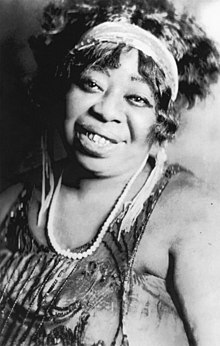
Ma Rainey

MaRainey.jpg
Ma Rainey – December 31, 1916

Ma Rainey was born with the name Gertrude Pridgett. Although Rainey claims to have been born on April 26, 1886 in Columbus, GA, the 1900 census indicates that she was born in September of 1882 in Alabama. Raised in a family of five children, Rainey quickly began performing at the age of 14 as a member of the First African Baptist Church. She eventually met her husband, Will Rainey, and thus her name transitioned from Gertrude Pridgett to Ma Rainey. Rainey and her husband performed music, becoming very popular and were called the “Assassinators of the Blues”. Her popularity grew over the years along side Blues music and was one of the pioneers for the musical genre.

Her popularity eventually crossed paths with legends such as Louis Armstrong, Thomas Dorsey, Joe “King” Oliver, and much more. Rainey signed a recording contract with Paramount, producing over 100 records over the next five years – further spreading her popularity across the South. This is when she earned the title “Mother of the Blues” as a marketing ploy. However, this stayed close to the truth because Rainey left such an incredible legacy in the music, Blues music, and African-American culture and industry. She was inducted into the Blues Foundation’s Hall of Fame in 1983 and the Rock and Roll Hall of Fame in 1990.

Ma Rainey’s original performance of “See See Rider” is quite an amazing one. It became a standard recorded by countless in many genres, including Elvis Presley. Ma Rainey performed this song as a mixture of blues and other popular music forms, primarily jazz. It doesn’t follow the blue’s standard twelve-bar blues and encompasses more variety of instrumentation – contrary to a blue’s typical single guitarist/pianist and vocalist. She performed this piece with the Georgia Jazz Band which included a banjo, a cornet, and a piano – untypical of a traditional blues song. Rainey performs in a very low-moaning melody with a structurally andante tempo. It’s clear that Rainey’s vocal performance is the key focus here, going from a high pitch to a low pitch as she sings. I think this provides a nice contrast of distant change compared to the static background band melody. The song does a play on words with “see see rider”, making it sound like “easy rider” which changes the story of the music. In dirty blues songs, easy rider refers to a woman who had very liberal sexual views, had been married more than once, or was skilled at sex. Most critics would argue that the rider referred to in Rainey’s song is about a man, but with the play on words could be referring to a prostitute – thus changing the story of the song.

Compared to “See See Rider”, “Countin’ The Blues” follows a more standard twelve-bar blues pattern with a simpler vocal (Ma Rainey), piano (Fletcher Henderson) , and cornet (Louis Armstrong) instrumentation. It plays in a very slow but steady pace with the instrments backing up as a fill after the end of Rainey’s verses. I really enjoy the follow up of the instruments after the verses as it plays similar fashion to a vocal-fashion – making it seem like the instruments are singing, rather than playing. It’s amazing to also hear Louis Armstrong’s famous “wah-wah” play style in his cornet as he provides a fill!

Sources 

https://www.aaihs.org/slavery-new-orleans-and-the-counting-blues/

Family Musical History

As previously mentioned on the discussion board, I talked about my family being involved with music early on in age. Through that, I started to look back on my personal evolution of musical tastes.

I firmly believe that I wasn’t an avid listener of music until eighth grade. What I mean by avid listener was that I had no opinion on music until I got my hands on a Samsung Music Player. This was back before iPods were as dominant. At this point in life, my experience in music and songs were heavily influenced by my sisters’ tastes – in this case, a lot of rap, country songs, and Korean Pop music. I remember downloading my playlist quite frequently from torrent sites, Napster, Limewire… I had a classmate named Tay who would always come over and ask me to borrow my player so he can listen to the latest rap songs.

It wasn’t until I got into high school when my sister introduced me to Deadmau5’s “Raise Your Weapon” which basically blew my mind because that was the first time listening to an electronic song. This is the point of my life where my taste in music changed drastically. Skrillex, Avicii, Calvin Harris, Klaypex, SubVibe, and many more were artists that I started to listen to quite frequently. I started leaning away towards popular billboard artists and rather more obscure, underground electronic artists. (I know some of the names listed are big names, but at the time they were up and coming or not as big as they are now).

So here I am:

  1. one side of the spectrum, I am actively listening to electronic/house/chillstep songs that prioritize beats and drops rather than from a lyrical standpoint
  2. I am very active in orchestra at this point where the expression of our music is through the different forms and styles of playing and other musical technicalities

And with these influences on how to interpret music, I truly believe that may have factored into how I am today where lyrics are hard to understand for me and music becoming a form of expression with regards to my personal emotions.

I’ve posted links to several songs that were frequently played by me. Perhaps listening to these songs could better express what I mean when I say music is more of a form of expression of emotions from the soundtrack rather than the lyrics.  ¯\_(ツ)_/¯

Deadmau5 – Raise Your Weapon
Blackmill – The Light
Getter Remix – Sierra Leone by Mt. Eden