

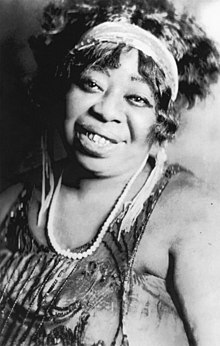
Bessie Smith was born in Chattanooga, Tennessee, on April 15th, 1894 into a family of six children. At the age of nine, Bessie’s father, William Smith, and her mother passed away suddenly – leaving her oldest sister, Viola to take care of the children. In order to make money and survive, Bessie and her brother, Andrew, began performing musical acts on the streets of Chattanooga. Their favorite location was in front of the White Elephant Saloon – the heart of the city’s African-American community.
Her brother Clarence left home to join a small traveling troupe – only to return in eight years. He allowed Bessie to audition to join the troupe, but was selected initially as a dancer because Ma Rainey was part of the troupe already. Eventually, Bessie started to sing chorus lines and performed live, eventually becoming popular. Bessie had a contralto voice and sung about the real African-American hardships. Her themes in her music revolved the inclusion of social issues such as poverty, racial conflict, and female sexuality. She sung “Down Hearted Blues” which was immensely popular during the time, selling over 780,000 copies in 6 months.
Bessie was the most popular African-American blues singer during her peak until her sudden and unfortunate death in a car accident in 1937. Her grave was left unmarked until August 7, 1970, when singer Janis Joplin and Juanita Green paid for the tombstone.
Bessie Smith earned the title Empress of the Blues and was one of the original pioneers of the jazz vocals.
“Down Hearted Blues” sticks to a classic blues structure with a duet of vocals and piano. It sold over 780,000 copies in 6 months, which in 1923, was a staggering amount of sales. It was the best-selling blues record of its time. Accompanying the piano piece, Bessie’s very low and slow singing style provides a nice swing-like melody. The lyrics tell a story about the man who doesn’t love a girl – which sticks true to the common motifs of the struggles faced by people, and a common theme she applied to her music. Her voice is very strong and confident but still manages to be light, not yelling like other singers during the time. The piano and light heartedness of the piano contrasts a lot with the actual story told by the song. The piano plays in a light tone, while the story tells about heartbreak and wanting for a better man. A lot of the popularity from this song has to do with the realism the song presents – as such many people were able to relate so much to it.
The true grittiness presented by this music and the depiction of the struggles really shows the hardships Bessie experienced. Her marriage was a struggle with constant cheating and fighting – she was known to drink and fight and argue. She was truly a harden woman, but the songs that she sang sung true to experience of life.
Originally written by Charles Warfield and Clarence Williams in 1919, Bessie Smith gives it her take in 1923 which stayed on the US top billboards for four weeks, ranking at number six. A lot of future artists will cover this piece and has become a jazz standard.
Going from the previous mentions of her crudeness and harden status as a woman, “Baby Won’t You Please Come Home” really reflects the story experienced by Bessie Smith. Her marriage was filled with cheating and partying – legends say that she beat her husband’s mistress unconscious on the streets of Harlem. She openly portrayed affairs with members of both sexes and had an appetite for music, alcohol, and sex. Even with these things, it really shows how strong of a figure Bessie represented for woman during this time. She was tenacious and successful.
She sings about the heartbreak that occurred when her baby leaves the home, but not enough to make them apart. She repeats the line the main line “Baby won’t you please come back home”, feeling lonely and sad. The syncopation that occurs in this song resembles that she sings how she wishes – that she paved her own music which reflects her strength and independence as a woman, and to tell her story how she likes too. This is a clear example of how she changed the music industry – providing a genuine and personal way of expression.
Sources:
Click to access Down-HeartedBlues.pdf
 Sunny's Musical Blog